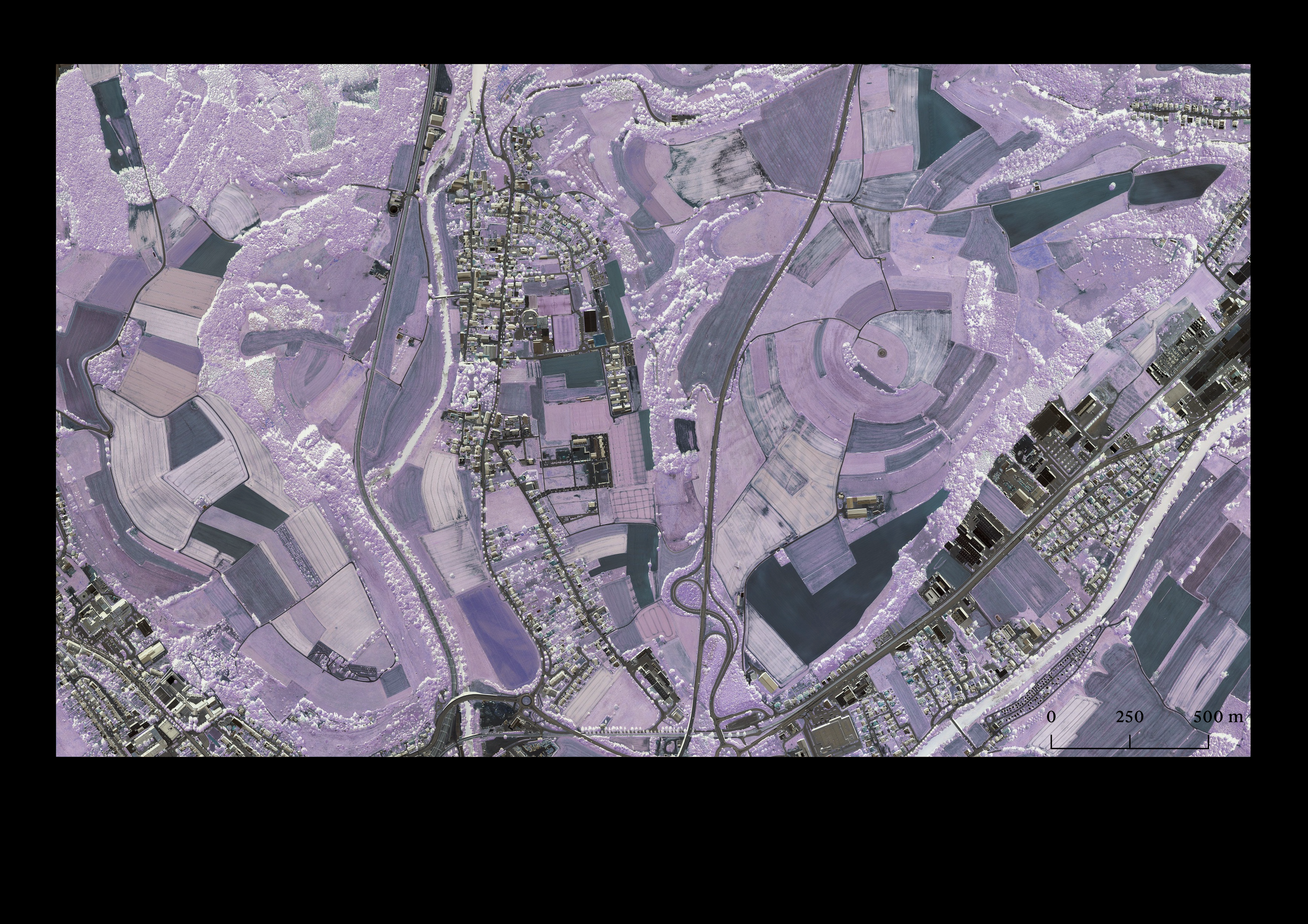
An Incomplete Cartography of "Banking"
Mapping the opaque structures of speculative/strategic land banking in Luxembourg
This project narrates the phenomenon of "banking" land – the practice of holding land over long periods of time, deliberately withholding it from the market for speculative/strategic purposes. In short: hoarding land. It uses Luxembourg as a case study: a country where speculative land banking has contributed to an artificial land scarcity and has become one of the main drivers of the country's extreme housing crisis.
Through exploring how "banking" can be understood beyond a purely financial operation, this project traces the story of Luxembourg's land and its banks. Two things that have shaped the country's past, defined its present, and will likely determine its future – and which, the longer you look at them, seem increasingly to be losing their traditional definitions, blurring instead into one another. This project attempts to understand this blurring, and what it leaves behind in the land itself. While the surface of the land may appear unchanged for years or even decades, legal, financial, administrative, and ecological processes continue to unfold underneath it. It therefore investigates and visualises these opaque structures/conditions, and how they shape both the landscape itself and access to housing in Luxembourg.
This project focuses particularly on exploring who controls time in relation to land, and what kinds of power emerge through strategies that treat land as a long-term storage device for value. The word "banking" is used here not simply in a financial sense, but more broadly as a way of describing practices that hold, defer, or withhold land over time.
What is the purpose of this platform?Luxembourg is particularly affected by the phenomenon of land banking which, combined with the oligopolistic structure of its housing and land market, has become one of the key drivers of the ongoing housing crisis in the country. Between 2010 and 2022, house prices in Luxembourg increased by roughly 150% — the largest cumulative increase in the European Union and the UK. Land banking has contributed to an artificial scarcity of buildable land. A 2019 study by the Luxembourg Housing Observatory found that Luxembourg has enough land to build between 50,000 and 80,000 housing units, yet around 70,000 citizens have left the country in search of cheaper housing in the three neighbouring countries — pushing housing prices up there as well.
This situation is the consequence of a strong concentration of land ownership and a very weak regulatory framework. Luxembourg has no inheritance tax on assets passed to direct-line relatives and no tax on vacant land or vacant housing. The structure of the land market today still resembles that of two centuries ago — large amounts of land remain concentrated in the hands of a small number of historic farming families, many of whom choose not to mobilise or sell their land.
Because land transactions are so rare, when land does come onto the market, it is usually purchased by the same large development companies – partly because the prices involved are so extraordinarily high that only a handful of actors have the capital to compete. This way they gain significant control over both the supply and pricing of housing. The same 2019 study found that the four largest property developers in Luxembourg control almost 32% of all residential land owned by companies. This is what Antoine Paccoud calls a "double concentration": land ownership concentrated among a small number of private landowners, and housing production concentrated among a small number of development firms — a system in which a very small number of actors effectively control both land supply and the timing of development.
Despite the scale of the problem, public discourse on land banking in Luxembourg remains remarkably limited. The phenomenon is rarely named, rarely debated, and rarely made visible. This platform is an attempt to change that.
MethodologyThis project started as part of an MA thesis at the Centre for Research Architecture (CRA), Goldsmiths, University of London.
It was developed in close collaboration with LISER (Luxembourg Institute of Socio-Economic Research) and their Housing Observatory. Special thanks to Antoine Paccoud for all the stimulating exchanges, as well as the generous help and support throughout the investigation.
Due to the limited access to the Luxembourg Land Registry – which restricts extraction to one parcel per day – direct data collection at any useful scale was not possible. The data used for this platform was therefore first collected through the scraping of atHome.lu, the largest land listings platform in Luxembourg, in order to better understand who is selling land and where. This produced a surprising observation: a relatively large amount of land was being offered for sale, which seemed to contradict the dominant narrative that land transactions in Luxembourg are extremely rare.
The current rise in land sales is directly linked to the present condition of the property market. Between 2020 and 2022, Luxembourg's property market reached record highs. Developers bought large amounts of land, anticipating that prices would keep rising. When interest rates rose sharply from 2022 onwards, this assumption collapsed – credit became significantly more expensive, and demand dropped. The scraping of the land listings website revealed these failed and suspended development projects: cases where developers had essentially "over-banked" the land and suddenly found themselves unable to sell. Selling land plots from these failed/suspended projects has therefore become a way to stay afloat while waiting for the market to recover.
Special thanks also to Markus Miessen and the team at Cultures of Assembly (COA) for their trust in this project and for including it in their urban research initiative The Esch Clinics (TEC) / Brill 24. By fostering space for dialogue and exchange in Esch-sur-Alzette, Luxembourg, they have helped this research move beyond academic discourse and reach broader audiences in a country where land is rarely talked about.
The "Banking" operation tries to impose a single rhythm onto all of this: the rhythm of capital, of manufactured delay, of waiting for prices to rise.
But land does not synchronise with the market. Because even if banked, land itself does not wait; it continues to live.
Land banking in Luxembourg is strongly facilitated by a weak socio-legal framework. The existing property tax system (impôt foncier, or IFON) is based on the German Land Tax, introduced in 1941 during the Nazi occupation of Luxembourg. After World War II, Luxembourg retained this framework – now completely outdated, it creates major market inequalities and almost no financial incentive to develop or sell land. Luxembourg charges 0% inheritance tax on assets passed to direct-line relatives (children, grandchildren, parents) and has no tax on vacant land or vacant housing. Even though municipalities can apply additional multipliers to certain land uses (such as the B6 tax on unused residential land), the overall financial pressure to mobilise land remains very small.
Property Tax Reform (Projet de loi n°8082)In 2022, the Luxembourgish government introduced a new reform bill (Projet de loi n°8082), which proposes a reform of the existing property tax system (IFON) and the introduction of new taxes designed to mobilise unused land (impôt à la mobilisation de terrains, or IMOB) and vacant housing (impôt sur la non-occupation de logements, or INOL). At first glance, the reform appears to challenge the current logic of land banking. However, in practice, the reform remains largely symbolic – the land mobilisation tax should technically apply from 2026 (this year!), but will have a 0% rate during the first five years, meaning that it creates no immediate financial pressure on landowners.
The political gap is therefore not simply the absence of regulation, but the fact that regulation itself remains delayed, weak, and easily adaptable to speculative strategies.
Get Involved!Since the tax reform remains largely symbolic, this project set out to create a petition to strengthen the reform and accelerate its implementation. However, the question of who gets to write such a petition – and how – became increasingly central. The ambition is for this petition to be the outcome of a collective effort, built together through dialogue and exchange. Rather than remaining within the refined intellectual discourse of academia, the goal is to translate this research to a broader public — without alienating wider audiences.
Do you want to know who owns the land in Luxembourg?
And how to recognize land banking patterns?
How the tax system works — and why it doesn't?
And help draft a petition that could actually change it?
Join the workshops at The Esch Clinics/Brill 24, in Esch-sur-Alzette. Together we will dig into the research behind this platform, understand how the land tax system in Luxembourg works, and co-draft a petition for real reform.
The workshops will take place in the fall/winter of 2026. More information coming soon.
Please feel free to send an email if you have any questions or comments!
This is an Incomplete Cartography of “Banking” – an attempt to map the opaque conditions of land banking in Luxembourg. By land banking I refer to the practice/phenomenon of accumulating undeveloped land for purely speculative purposes and with no intention of developing it in the near future. In short: hoarding land.
The Cartography is incomplete because this project investigates only the 'tip of the iceberg' – suspended and failed development projects traced through the scraping of land listings data. It therefore visualises only a part of the problem and does not constitute a representative sample. Other cases, even more invisible, remain harder to trace and continue to be hidden.